An Anxious Generation—of Parents
Jesus told us not to worry, but worry is our culture’s parenting default. It’s harming our kids.

As my daughter dangled 10 feet above the ground, legs wrapped around the thick, smooth trunk of a vine in the middle of the Belizean jungle, I stood below her and considered how far she was from solid ground, a paved road, and the nearest hospital.
Needless to say, this had not been on my agenda for the day. We were visiting a small village on a mission trip to western Belize with friends from our church who’ve been coming annually to the same town for more than a decade. Our task was to help in the village school, support community development projects, share the love of Jesus, and deepen friendships with people who live in a totally different cultural context from our own.
It was that last part that put my daughter up the tree. We took a morning walk to see some little-known Mayan ruins but detoured to a no-safety-harnesses jungle adventure course led by Crocs-wearing Julio, our local friend who clearly didn’t find it worrisome to let a child free climb.
Back home in the States, we’re constantly worried about our kids. It’s well-documented and generally accepted that smartphones, social media, and a lack of childhood independence and free play contribute to creating what social psychologist Jonathan Haidt famously dubbed an “anxious generation.” But in all this collective handwringing, we tend to overlook a closely related and equally pervasive problem: unchecked, socially normalized parental anxiety and the smothering parenting style it produces.
There’s nothing new under the sun, and I’m sure, to some extent, that’s true of parental worries. Throughout the ages, parents have feared losing their children to sickness, accidents, or violence. Right ...


 Christianity Today Magazine
Why Evangelicals Are Leaving Protestantism for Other Traditions
A number of high-profile Christians have converted to Roman Catholicism and Eastern Orthodoxy. Why should we stay?
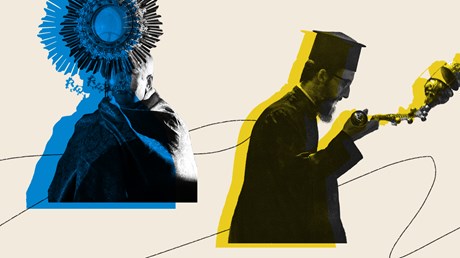
In recent decades, there has been a significant and sustained trend of Protestants converting to Roman Catholicism and Eastern Orthodoxy. The most notable figure recently is J. D. Vance, the vice-presidential running mate of former president Donald Trump.
But he’s not alone. Vance is just one name in the growing list of high-profile, theologically conservative Christians who have made public shifts away from their Protestant backgrounds (often evangelical) to these more liturgical or “high church” traditions.
Earlier this year, Candace Owens, a controversial conservative voice, announced on the social platform X that she had “made the decision to go home,” in reference to her return to Roman Catholicism. Cameron Bertuzzi of Capturing Christianity, a prominent YouTube channel, reportedly became a Catholic in 2022, and Hank Hanegraaff (the “Bible Answer Man”) of the Christian Research Institute converted to Eastern Orthodoxy in 2017. Another, Joshua Charles, joined the Catholic church in 2018 and has since become very vocal about both his conversion and his defense of Rome’s doctrines.
Of course, there are always exceptions to every trend, as is the case with former Eastern Orthodox priest Joshua Schooping, author of Disillusioned: Why I Left the Eastern Orthodox Priesthood and Church, and Brad Littlejohn and Chris Castaldo—a Catholic turned Protestant—who together published Why Do Protestants Convert? last year.
This perceived trend also does not appear to be the case in nondenominational churches, since, according to a previous article from CT, former Roman Catholics have gone from comprising 6 percent of nondenominational congregations to 17 percent in the past 50 ...
Evil Is Not the Essential Feature of Reality
Russell Moore is joined by Marilynne Robinson for a conversation on reading Genesis as a story of grace.

This article is an excerpt of a conversation on CT’s podcast The Russell Moore Show. Listen to the full conversation here.
Russell Moore: I’ll tell you what was surprising to me about Reading Genesis: I expected certain themes to be there—such as the mystery of human beings and the fact that we’re not reducible to causes and effects. But one of the things I was surprised by is that this is a book about grace and forgiveness. The Cain and Abel narrative shows up repeatedly in ways I hadn’t considered—from Lamech all the way on to Joseph and his brothers.
There is a sense of moral shock in the fact that God would protect Cain after killing his brother. And it struck me that, as with so many other things in the Bible, the familiarity that we have with it reduces that sense of shock that that is intended.
Marilynne Robinson: It was a question that came up in a class, but it shocked me too. And I think that was the beginning of my reappraisal of these stories, because the obvious importance of Cain and Abel is a master narrative of so much else. The mark of Cain, which we know protected him, was something that stigmatized him.
RM: I’ve kind of unconsciously seen the story as primarily about Cain and Abel’s rivalry, Abel’s subsequent murder, sacrifice, and so forth, and only secondarily about God’s response to Cain. But now, after reading your book, I’m rethinking that because it seems that the most startling thing here is not just a brother’s blood cries from the ground, but that God doesn’t execute the murderer—he protects him. And that’s something that you demonstrate repeatedly through Reading Genesis.
MR: It’s such a strongly recurring ...
I Grew Up Serving the Church in the Middle East. Coming ‘Home’ Was Hard.
My return to the United States brought grief and loneliness as I realized I was different from my peers.

On an early morning flight out of the country, I claimed the window seat. Alongside the usual anticipation that accompanies travel, I felt joy and fear and sadness. I don’t remember if I cried. What I do remember are the mountains, the wobbly takeoff in the rundown plane, and the small comfort of knowing that I didn’t forget anything. Everything we owned sat in the belly of the plane, packed neatly into a dozen trunks and a few suitcases.
That was almost four years ago.
Most people would never guess now that I spent my childhood as a homeschooler in northern Iraq. Our family moved to the country to serve the Kurdish church when I was six; we moved back just before I turned 18. And when we returned, I did my best to erase every trace of those years from myself.
But their impact, of course, has remained. I still blank when someone asks where I’m from. I have struggled to find an identity outside of “the girl who lived in Iraq.”
I have a tattoo of the mountains on my right forearm now, and a reference to Joshua 1:9 in Kurdish: “Have I not commanded you? Be strong and courageous. Do not be afraid; do not be discouraged, for the Lord your God will be with you wherever you go.” The tattoo is a tether to the place that was both home and foreign, the place that I love and hate, fear and miss; the place that elicits just about every possible emotion.
That first fall back in the United States, after I graduated from high school, I moved to the Northwoods of Wisconsin for nine months to attend a gap year program. It was one of the worst years of my life. I know now that no matter where in the United States I’d been, this season would have been a dark one. I was anxious, depressed, and lost, ...
Some Churches Lose Coverage as Insurers Hit by a Wave of Storm Claims
Natural disaster costs have overwhelmed the market for carriers, which are raising rates or dropping policies for congregations in high-risk areas.
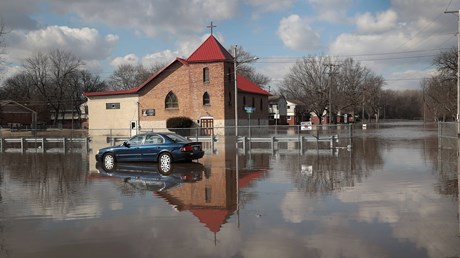
John Parks was taking his first sabbatical in 40 years of ministry when he got a call from his church’s accountant with some bad news.
Church Mutual, the church’s insurance company, had dropped them.
“This does not make sense,” Parks, the pastor of Ashford Community Church in Houston, recalls thinking at the time. “We’ve never filed a claim.”
Five months and 13 insurance companies later, the church finally found replacement coverage for $80,000 per year, up from the $23,000 they had been paying.
“It’s been an adventure,” said the 69-year-old Parks from his home in Houston, where the power was out after Hurricane Beryl. “That’s putting it politely.”
Parks and his congregation are not alone. An ongoing wave of disasters—Gulf Coast hurricanes, wildfires in California, severe thunderstorms and flooding in the Midwest—along with skyrocketing construction costs post-COVID have left the insurance industry reeling.
As a result, companies such as Church Mutual, GuideOne and Brotherhood Mutual, which specialize in insuring churches, have seen their reserves shrink. That’s led them to drop churches they consider high risk in order to cut their losses.
Hundreds of United Methodist churches in the Rio Texas Annual Conference learned they’d lost property insurance in November last year, leaving church officials scrambling. More than six months later, some churches have found new insurance, often at a steep increase. Others still have none, said Kevin Reed, president of the conference board of trustees.
Reed said the conference had about a month’s notice that its property insurance policy, which local congregations could buy into, was being ...
Homeschooling for the Common Good
I never thought I’d be a homeschool parent, not least because I support public education. An improbable shift changed my perspective.

I am an educator. I believe in the good of education for everyone and that public schools should be amply funded and resourced. I believe in contributing to the common good even when it doesn’t directly benefit me. And in the summer of 2020, my wife and I found ourselves in what I’d once have called a most improbable situation: We became homeschool parents.
Let me explain.
One of the attractive parts about moving to Abilene, Texas, five years prior was the well-loved public school system. We bought our house near one of the many excellent elementary schools and expected an ordinary educational path for our two children. We’ve long known public school teachers, happily paid taxes for schools our children didn’t attend, and looked back fondly on our own days of bus rides, locker conversations, and school cafeterias.
Then COVID-19 came. Suddenly, we realized our our oldest would be going to kindergarten masked, unable to see his teacher’s face, distanced from other children—or else staring at a screen for hours a day in virtual kindergarten. Guidance from the school board was minimal, and the deadline to register our child for COVID kindergarten ticked ever closer.
We couldn’t do it—but we realized we could handle homeschooling, at least for a while. Both my wife and I could do some of our work remotely, and we could convert part of our living room into a classroom. It would be hard, but we could make it work.
“One year,” we said. “We can do one year.”
Let me say, now, that making this decision was not a brave one. It was simply the only one we felt was available to us. Had COVID not forced our hand, I’m not sure we’d ever ...
You Cannot Lie Your Way to the Truth
Falsehoods are easy to tell in politics, and they can even creep into the church. But nothing takes us farther from the Truth himself.
This piece was adapted from Russell Moore’s newsletter. Subscribe here.
When Democratic presidential nominee Kamala Harris chose Minnesota Gov. Tim Walz as her running mate this week, some people took to social media to contrast him with his Republican counterpart, J. D. Vance. Lots of those contrasts were fair game—that of a former high school coach versus a Yale venture capitalist, for instance. Some people framed the contrast this way, though—Walz is a normal guy, while Vance is a weirdo who has sex with couches.
The past several years have required sentences I never imagined I would write. Here’s another: J. D. Vance did not have sex with a couch. I believe the proposition I just wrote to be true, and my opinion of the politics or personality of the Republican vice-presidential nominee has nothing whatsoever to do with that belief.
Some might stop me at this point to note that everybody knows that J. D. Vance didn’t have sex with a couch. It’s a joke; a social media meme, started when someone posted a parody, allegedly from Vance’s memoir Hillbilly Elegy. These people know, however, that most people don’t follow the genealogy of memes back to their origins. Many people just start to think, “J. D. Vance is sort of a freak; people say he did something with a couch one time.”
The Vance couch meme-posters can have it both ways. They can kind of do what the Bible describes as deceiving one’s neighbor and then say, “I was only joking!” (Prov. 26:19). Beyond that, they can say, “Well, of course, Vance did not literally have sex with a couch. The point is that Vance is kind of weird; the couch just makes the point.”
If this were just this momentary ...
The Olympics’ Most Iconic Photo Has a Christian Message
The raised index finger of levitating surfer Gabriel Medina is the latest sign that sports success has made Brazilian evangelicals less marginalized and more confident.

There’s a hidden Christian message behind what may be the most celebrated image of the 2024 Olympics.
On July 29, in round three of the shortboard surfing competition, Brazil’s Gabriel Medina faced off against Japan’s Kanoa Igarashi, who eliminated Medina in the last Olympics. In his second wave, Medina emerged from a tube exuberant, with both palms open, suggesting that the judges should offer him a 10 for his performance. (Two of the five judges agreed; his final score was 9.9).
Medina then pivoted left, toward the surf, and jumped off his board, raising his right hand and pointing his index finger upward. This was the image that Agence France-Presse photographer Jérôme Brouillet captured.
Brazilian evangelicals recognized the sign immediately.
“It's like he’s saying, ‘It's not me you should be looking at, it’s God. This moment of glory is not mine, but his,’” said João Guilherme Züge, a resident historian of religion at Museu Paranaense, in Curitiba.
In contrast to the United States, where baseball players often point to the sky after hitting home runs for different reasons—some to express gratitude to God, others to honor late loved ones—the gesture among Brazilian athletes has become closely associated with Christian players.
The raised finger, pointing to the sky, has been the trademark of Brazilian evangelical athletes for more than 40 years, one of numerous public displays of faith following competitive glory that have helped to affirm and establish evangelical identity, especially when the movement was still in its infancy.
No one seems to remember who initially created the gesture, but it gained popularity in the 1990s, ...
Watching the Olympics as a French Christian
Evangelical leader Erwan Cloarec shares his reactions to the opening ceremony, why he is enjoying the games, and how he hopes the church is seizing the moment to live out its faith.

On Sunday, at the start of the second week of the Olympics, France won its 44th medal, surpassing its previous record total for a modern Olympics. Few might have predicted either the country’s extraordinary athletic success or the this national joy, which seemed in short supply after contentious snap national elections in June and July.
But for some French Christians, negative feelings emerged again following the controversial opening ceremony. Erwan Cloarec, president of the Conseil National des Évangéliques de France (CNEF), noted this “distress” last week in a statement, adding that he and the director general of CNEF would be meeting with the Central Office of Religious Affairs at the Ministry of the Interior that day to advocate for a “secularism which makes room for everyone” and for “state guarantees that all, believers or not, will be respected in their essential convictions.”
Cloarec pointed out that many Christian ministries had spent months anticipating that the Olympics would offer them an opportunity to live out their faith to the thousands descending upon the city. Through Ensemble2024, evangelical congregations and ministries have organized community tournaments, a K-Pop worship service, an exhibition examining the intersections of body, sport, and spirituality, a day of surfing, and a praise festival, as well as handing out water bottles and hygienic products. They have also provided chaplains to athletes and offered opportunities for Christian athletes to share their testimonies.
“Let us see in the situation that has arisen a real opportunity to bear witness to our faith while the person of Christ has just been placed at the center of these games,” ...
Died: Doris Brougham, Missionary Who Taught English to Taiwan
For more than 70 years, Brougham used Studio Classroom and her trumpet to introduce Taiwan to Jesus.
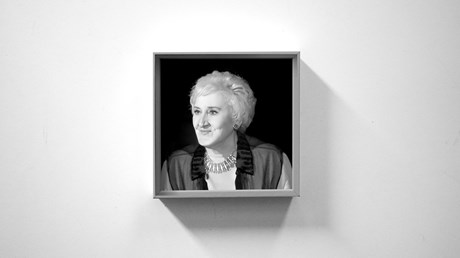
Doris Brougham, an American missionary, who for 70 years used English and music to share Christ with millions of Taiwanese people, died Tuesday at the age of 98.
Through radio, television, magazines, live performances, and in-person classes, Brougham’s organization Overseas Radio & Television (ORTV) taught everyone from dignitaries to middle school students how to speak English. At the same time, she held weekly English Bible studies and started a popular Christian singing group called Heavenly Melody.
Brougham’s contributions to Taiwan led her to receive its highest civilian award, the Order of the Brilliant Star with Violet Grand Cordon, in 2002. Last year, then-president Tsai Ing-wen made an appearance on ORTV’s show Studio Classroom to hand-deliver Brougham a Taiwanese passport, a special honor given 72 years after she first arrived in Taiwan.
“Her story brings tears to [my] eyes,” wrote former Taiwanese president Ma Ying-jeou in the preface of the 1998 Chinese-language biography on Brougham. “She is the English teacher of 20 million people [the population of Taiwan], cultivating countless professionals in the English education field. ... How many people have listened to her broadcasts and read her articles? Surely more than 20 million.” While, today, Brougham is the most well-known American in Taiwan—where Christians make up 7 percent of the population—she never planned to come to Taiwan in the first place. The missionary’s initial aim was to minister to mainland China, but the Chinese Civil War forced her to change plans and move to Taiwan (then called Formosa). Her love of music led her to start the first Christian radio station, the beginning of what ...
The Top Christian Highlights of the Paris Olympics
How athletes are sharing their faith and pointing to God.

For most spectators, the Olympics are a display of the highest level of athletic skill. But for many Christian athletes, they provide an opportunity to express their faith to each other and to the world. Below are some of the most memorable moments of Christian expression at the Paris Olympics.
Gospel Music Invades Press Conference after German Christian Wins Shot Put
German shot-putter Yemisi Ogunleye got off to a rough start in her competition on August 9, slipping and falling in rainy conditions on her first throw.
Despite a sore knee, Ogunleye recovered with an excellent second throw to qualify for the finals and was in second place entering her last attempt. She rose to the occasion with a throw of exactly 20 meters (65 feet, 7.5 inches), her best ever in outdoor competition, to win gold.
Asked how she approached that decisive final throw, Ogunleye replied, “Before the last attempt, I didn’t think about anything but just lifted my hands and prayed. And that might seem weird to some people, but that is really the source of my peace and joy. … After seeing where the shot landed, when I knew it was hopefully going to be enough for the gold medal, I just went on my knees and said, ‘Thank you, Jesus.’”
At the end of the post-event media conference, the moderator asked Ogunleye, “Is it true that you sing in a gospel choir? What song was going through your head tonight?” She responded with an impromptu rendition of “God Kept Me” by Harvey Watkins, Jr.:
I was right at the edge of a breakthrough but I couldn't see it. The devil really held me; but Jesus came and grabbed me, And ...
What Churches Lose When They Fight like the World Fights
A journalist counts the cost of prolonged cultural conflict in the life of one fractured congregation.

By now, you’ve seen the statistics. In the United States, churches are shrinking. Christian belief is waning. “Nones” comprise a greater share of the population than Protestants or Catholics. And the trendlines don’t look good.
By now, you’ve also seen the explanations—many of them published in the pages of Christianity Today. Leadership crises, denominational tussles, and sexual-abuse scandals have depleted the trust congregants have in their pastors. Congregations have split over political candidates and masks and vaccines and critical race theory and LGBTQ inclusion and women in leadership.
These explanations are right. But to me at least, they increasingly feel like a set of abstractions. They’ve been repeated so many times over the past several years as to have lost their meaning—so rote, by now, as to obscure particularities.
In her new book Circle of Hope: A Reckoning with Love, Power, and Justice in an American Church, Pulitzer Prize–winning journalist Eliza Griswold offers no such obfuscation. Through painstaking observation of one church over many years—Circle of Hope, a progressive evangelical community with “cells” across New Jersey and Pennsylvania—she reveals how the histories, gifts, and besetting sins of particular Christians in specific circumstances react to monolithic cultural pressures. Through her reporting—rigorous, expertly paced, never polemical—she also reveals what’s at stake.
Utter estrangement
Circle of Hope was founded in 1996 by former Jesus Freaks Rod and Gwen White. From the very beginning, the Anabaptist congregation ran counter to the predominant political and cultural conservatism of the Religious ...
The Evangelical Diploma Divide
How a new class division burst into American evangelicalism—and what it means for church unity.

The United States is now in the throes of the politics of class division, and American evangelicalism is no exception.
College-educated evangelical Christians may be the least prepared for this new class-based polarization, because it doesn’t break along old class fault lines. As recently as two decades ago, social class in the US was primarily determined by income or wealth, “haves” pitted against “have-nots.”
But today’s most intractable class divide is about education, and educated evangelicals are having a hard time navigating this split. After all, the college-educated are a minority among white evangelicals, only 29 percent of whom have four-year college degrees.
I say this—as an evangelical with not only a four-year degree but a PhD—not to seek pity for the new educational elite. We don’t need commiseration. But we do need unity in the body of Christ. So what should we do when our education divides us from our Christian brothers and sisters? What do we do when the values we’ve acquired from our schooling lead us down a political path that many non-college-educated evangelicals view as dangerously wrong?
It’s only in recent years that education has become such an important political predictor. “Among white voters, in particular, individuals with at least a college degree are now a much more Democratic constituency than people with less schooling,” The New York Times reports. Meanwhile, whites without a college degree are moving rapidly into the Republican Party.
This is a reversal of traditional patterns, because, for many decades, the GOP was the party of the affluent and upper middle class, while Democrats relied heavily ...
Interview: Why Changes to India’s Colonial Criminal Code Concern Christians
A Supreme Court lawyer on how recent legal reforms could affect the country’s minorities.
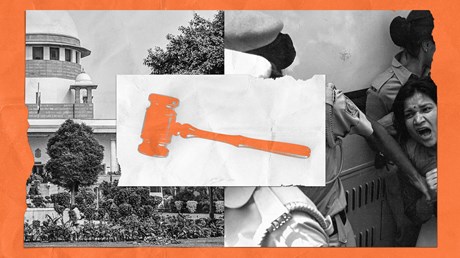
On June 23, authorities arrested Sarju Prasad, a pastor in Uttar Pradesh, for conducting Sunday worship in his house. Earlier that day, two Hindu men, one claiming to be a journalist, had entered his house during the morning service and taken photographs.
That evening, two policemen detained Prasad on charges of plans to commit cognizable offenses. However, their explanations only came out later; at the time, they did not notify him of the grounds of arrest, a violation of India’s Code of Criminal Procedure. They also ignored the procedure’s requirement that the offender be brought before a judge within 24 hours of being taken into custody.
Instead, Prasad was only presented before a magistrate two days later and was released on bail on June 25. Shortly after, on July 2, while collecting his cell phone at the police station, authorities re-arrested him, saying that he had violated the state’s anti-conversion law. This time, he was denied bail and is now in prison.
Prasad’s case is just one of many where the local police have allegedly colluded with Hindu extremists and arrested Christians conducting peaceful prayers, tyrannizing their rights. Indian Christians are apprehensive about what might happen under the new criminal laws that have replaced their three British-era counterparts. Described as “draconian” by some legal experts, the legislation has elicited criticism and protests, and Christian, Muslim, and other vulnerable communities fear possible abuses of the new laws.
The Parliament of India approved the three new laws last December without following due process, according to the opposition. They replaced the Indian Penal Code with the Bharatiya Nyaya Sanhita (BNS), the Code of Criminal ...
How to Read the Bible in Color
Why a group of multi-ethnic editors began working on a new commentary of the New Testament.

I was sitting in a coffee shop, books taking up too much space on the tiny table in front of me, bemoaning the lack of attention the academy paid to the Black church and the distinctive interpretative habits of African American church leaders and scholars. My time in religious higher education had signaled, in ways large and small, its belief that the tradition that shaped me had little to say to the rest of the world.
The important ideas and trends arose in Europe or white North American spaces—Black Christians, on the other hand, were historically deemed theologically simplistic or dangerous. But I longed for people to know the tradition as I experienced it: life-giving, spiritually robust, and intellectually stimulating. We had wrestled with God and found our way toward faith in the context of anti-Black racism often perpetuated by other Christians. I wanted to make that story and the fruits of our labor known. I still do.
While I sipped my coffee, I was struck by an idea that served as the genesis for The New Testament in Color: A Multiethnic Commentary on the New Testament. I often complained about white scholars neglecting African American voices, but I knew little about Asian American biblical interpretation, its theological and historical developments, and the gifts it offered to the body of Christ. The same was true regarding Latino interpretation and the Bible-reading habits of First Nations and Indigenous peoples.
In some ways, I was a hypocrite. I wanted people to attend to the contributions of my community without being similarly invested in others. I needed to spend less time complaining and more time listening. The New Testament in Color thus began with that insight. It was a hope ...
Gordon College Loses Religious Liberty Case for Loan Forgiveness
Evangelical school sees discrimination in COVID-19 relief fund’s employee-counting rules.

Gordon College could be on the hook to repay $7 million of COVID-19 relief funds. A federal court rejected eight of the evangelical school’s arguments that it should be eligible for loan forgiveness.
Gordon’s lawyers made the case that the religious liberty protections in the First Amendment and the Religious Freedom Restoration Act should allow the institution to count employees in a different way than the US Small Business Administration (SBA) said they had to be counted. The US district court in Washington, DC, rejected the argument, citing a lack of evidence.
“Plaintiff alleges no facts connecting its number of employees to any religious practice,” Judge Beryl A. Howell wrote in a ruling handed down in July. “Plaintiff fails to identify any ‘exercise of religion’ that has been burdened, and thus plaintiff’s claims can be dismissed on this basis alone.”
According to the government, Gordon has 639 employees on its wooded campus on the North Shore of Boston. Some of those people only work part time, however. So the school calculated the full-time equivalent, which is a common way to track enrollment in higher education. If you don’t tally individual people working at the school, but instead count units of time worked, Gordon only has 495.67 employees.
Organizations with fewer than 500 employees are eligible for loan forgiveness.
The government gave out nearly $800 billion as part of the Coronavirus Aid, Relief, and Economic Security Act passed by Congress and signed into law by President Donald Trump in 2020. The vast majority of recipients have since had their debt waived. Gordon is an exception.
In court filings, the law firm Gammon and Grange said the SBA’s ...
East Asians Leave Childhood Religion Most in World, but Remain Spiritual
(UPDATED) Pew survey of more than 10,000 adults in Hong Kong, South Korea, Japan, Taiwan, and Vietnam examines Christians’ and Buddhists’ beliefs, practices, and affinity to other traditions.

The rate of religious conversion in East Asia is among the highest in the world: Half of adults in Hong Kong and South Korea have left the religion they were brought up in for another religion or no religion.
Among Christians, substantially more adults in those two places left the faith than those who converted to Christianity.
The region also has the highest levels of deconversion. More than a third of adults in Hong Kong and South Korea say they now no longer identify with any religion.
Yet at least 4 in 10 adults in East Asia and Vietnam who are religiously unaffiliated still believe in unseen beings or a god.
And about 80 percent of Taiwanese and Japanese adults say they burned incense to honor their ancestors in the past year. These are among the findings of “Religion and Spirituality in East Asian Societies,” a massive report released today by Pew Research Center. While few people in the region pray daily or say religion is very important in their lives, many “continue to hold religious or spiritual beliefs and to engage in traditional rituals,” said Pew researchers.
Surveys of 10,390 adults in Hong Kong, Japan, South Korea, and Taiwan—defined here as East Asia—and Vietnam were conducted between June and September last year.
Although Vietnam is located in Southeast Asia, Pew included the nation in this survey due to its adoption of Confucian traditions, its historic ties to China, and its embrace of Mahayana, a branch of Buddhism common across East Asia. (Last September, Pew released an in-depth survey on religion in Southeast Asia, highlighting six nations.)
Researchers acknowledged the complexity of measuring “religion” in the region, as this word often denotes organized, ...
Sunday Silence: Gateway Church Doesn’t Tell Congregation About Historic Abuse Allegations
According to the Texas megachurch, founder Robert Morris properly disclosed his misconduct and has had “no other moral failures” since he touched a child in the 1980s.

Gateway Church did not address allegations of past abuse—or “moral failure”—by its senior pastor, Robert Morris, when it gathered to worship this weekend, just a couple days after a woman who said he molested her starting at age 12 in the 1980s shared her account online.
The Southlake, Texas–based megachurch made a last-minute change so that its executive pastor, Kemtal Glasgow, could take the stage instead of the guest speaker, Albert Tate, who was scheduled as a part of Gateway’s summer series and who was himself placed on leave last year by his church in California over inappropriate text messaging.
Glasgow, who said he was on his way to church when he got the call that he would be filling in that day, preached about patience, listening, and waiting on the Lord. His message was broadcast across Gateway’s 10 campuses, which draw around 25,000 people in-person each week. He did not mention Morris or any abuse allegations.
Morris, 62, founded Gateway in 2000, and it has grown to become one of the biggest megachurches in the US. He also has a global following, thanks to his programs broadcast on Christian TV and radio. Morris formerly served as a faith advisor to President Trump and had been an advisor for Mark Driscoll’s new church.
Nondenominational and charismatic, Gateway is one of the top producers of evangelical worship music. Singer Kari Jobe served as its previous worship leader, and Gateway Worship music was streamed over 300 million times last year alone. On Sunday, the congregation opened with one of its own hits, singing “Praise the Lord.”
Southlake’s campus pastor, Lorena Valle, also did not bring up the scandal when she spoke to the congregation. A ...
Bavinck Warned that Without Christianity, Racism and Nationalism Thrive
The Dutch theologian argued the biblical worldview is fundamentally incompatible with ethnocentrism.

It’s no secret that Dutch theologian Herman Bavinck has enjoyed a renaissance in the past few years, as James Eglinton also pointed out in a previous piece for CT.
Ever since the English translation of Bavinck’s landmark work, Reformed Dogmatics, was released in 2008, there’s been a constant stream of fresh readings of his life and thought. More recently, new translations of lesser known but no less important texts include his Christian Worldview, Christianity and Science, and Guidebook for Instruction in the Christian Religion; and new editions have been published of Philosophy of Revelation, based on his 1908 Stone Lectures, and The Wonderful Works of God.
Theologians like me are also rediscovering the neo-Calvinist tradition shaped by Bavinck and his fellow Dutch theologian, Abraham Kuyper, and examining how these thinkers might engage with cultural issues today, including our nation’s reckoning with racism. And while many have recently (and rightly) criticized Kuyper’s checkered legacy on this issue, they have often neglected Bavinck’s contributions on the subject, which many scholars see as an improvement on Kuyper.
Bavinck’s assessment has enduring lessons for American Christians living in a polarized political climate. Similar to Bavinck’s own context of 19th-century Europe, those in the US today are confronted by the challenges of living in an increasingly post-Christian culture. This has led to heated debates on the identity of America, Christian nationalism, and how we can all find common ground amid our substantial differences.
Bavinck and Kuyper’s neo-Calvinist Christian worldview, for instance, affirmed the diversity of reality but saw ...
Paternity Leave Made Me a Better Christian Dad
Time off at the very beginning helps fathers prepare to bring up their children in the “discipline and instruction of the Lord.”

When our first daughter was born, in the fall of 2021, she couldn’t nurse properly. For my wife, feeding her was an every-few-hours exercise in pure pain. Lactation consultants were consulted, to little avail; a minor tongue-tie operation, newly trendy in such cases, didn’t help either. We thought about switching to formula, but my wife was dead set on seeing nursing through.
So we triple-fed: She would nurse the baby through gritted teeth for as long as she could stand it, while I tried my best to distract her—singing songs, reading, putting something on the TV. Then I’d take the kid and finish the feeding by bottle while my wife pumped. As it turned out, the baby just needed to get a little bigger. By eight weeks, my wife’s pain was gone.
When our second daughter was born last year, the process seemed to restart—then unexpectedly cleared up in week two. The bigger challenge, it turned out, was managing the emotions of the now-toddler, who found herself, unexpectedly, no longer the center of the known universe.
After a period of protest, she settled into a new equilibrium. Yes, mom had a new baby, but she still had dad. For those first few weeks, the toddler and I were inseparable. (I made time for mom and baby too!) Soon, she had grown to like her little sister enough for us all to reintegrate as one happy family.
Both these stories have a key subtext: I was on paternity leave. Under my then-employer’s heroically generous, deliberately pro-family policy, I was free to take up to 12 weeks off per child to help my wife recover from childbirth and to bond with our new arrival.
I was lucky; that arrangement is rare. Most American fathers take only a short stint ...
You Abused and Oppressed Me, Dad. I Forgive You.
How a community’s example of radical forgiveness helped me relinquish my own rage.
Father’s Day is a multibillion-dollar affair. In the weeks leading up to it, men’s ties, BBQ aprons, and golf-themed gifts fly off the shelves.
My own view on Father’s Day has a complicated history. After an abusive, impoverished childhood (detailed in my recent memoir, Motorhome Prophecies), I sometimes felt an anger toward my dad as intense as what Salvador Dalí, the Spanish surrealist painter, felt toward his own father.
I first fell in love with this brilliant artist while visiting a museum dedicated to his work in sunny St. Petersburg, Florida. It’s a futuristic, fantastical building filled with spacious, airy light flowing through a glass atrium entryway attached to 18-inch thick concrete. It’s a captivating and fitting home for this revolutionary man who pushed the boundaries intersecting art, science, and metaphysics.
Dalí clashed for decades with his father, a mid-level civil servant who didn’t appreciate his son’s creative, rebellious nature or his association with the surrealist movement. Adding insult to injury, he disapproved of his son’s muse and future wife, Gala. Dalí said he considered his true father to be psychologist Sigmund Freud, and later, quantum physicist Werner Heisenberg. Legend has it that Dalí gave his biological father a condom containing the artist’s own sperm, exclaiming, “Take that. I owe you nothing anymore!”
Obviously, that’s disgusting. But I confess there was a time in my life when I might have considered buying a sperm sample from a donor bank and sending it to my dad. I thought he’d die before I’d ever speak to him again.
God’s healing balm
As I shared earlier this year for ...
Church ‘Homelessness’ Must Not Be Grieved Too Quickly
It’s okay to mourn what’s lost without losing hope for what’s to come.

This piece was adapted from Russell Moore’s newsletter. Subscribe here.
In his New York Times column this week, my friend David French wrote about what it was like to be “canceled” by his denomination, the Presbyterian Church in America. He later told me how stunned he was by how many people responded immediately—grieving their own “cancellations” from churches or ministries they’d loved and served.
I was not surprised at all.
Most people, of course, aren’t canceled in the way we typically use that word, but in a way more like the situation described by the late Will Campbell. He wasn’t “fired” by the National Council of Churches, he would joke. They just unleashed a swarm of bees in his office every day until he voluntarily left.
Similarly, many people who feel “homeless” these days aren’t told by their home churches or traditions, “Get out!” Instead, they face a quieter form of exile.
They face those they love, who expect them to conform to new rules of belonging. Sometimes, that’s to some totalizing political loyalty. Sometimes, it’s to a willingness to “get over” their opposition to whatever their church or ministry leaders now deem to be acceptable sins. Sometimes, this doesn’t even happen to these people in their own churches but in their larger theological or denominational homes, or vice versa. It’s confusing. It’s disorienting. It’s sometimes angering.
What it really is, though, is grief.
People who’ve faced this in their own contexts often ask me, “How long does it take to get over this?” I usually quote the landslide-losing presidential candidate George McGovern ...
PCA Will Investigate ‘Jesus Calling’ Book
The author of the bestseller died last year. The investigation will determine if the book is appropriate for Christians.

The Presbyterian Church in America (PCA) at its annual meeting on Thursday voted to investigate the Christian appropriateness of the best-selling book Jesus Calling by Sarah Young, who was part of the PCA and died in August last year at age 77. Young was one of the most-read evangelicals of the last 20 years.
Pastors in the denomination are concerned that Young’s use of the voice of Jesus in the book undermines the concept of sola Scriptura and might amount to heresy. The book was published in 2004, and criticisms of its theology from leaders in the denomination have already been widely circulated.
In addition to having a degree from the denomination’s Covenant Theological Seminary, Young was the wife of a PCA elder and missionary to Japan, Steve Young.
At the debate on the measure, the recent widower rose and spoke to the room of several thousand church leaders, asking the assembly to vote against the investigation.
“Her writings did not add to Scripture but explain it,” Steve Young said. “She would stand with Martin Luther and declare that her conscience was captive to the Word of God.”
He went on: “Sarah is a sister in Christ and wife who delighted in the law of the Lord, and on his law she meditated day and night. She was led to share her meditations with the world.”
Young herself said her devotions were meant to be read “with your Bible open.”
The measure passed by a relatively close vote, 947–834, with 20 abstentions. It directs two denominational committees to answer a set of questions on the book and to each issue a report.
The committees must look at the denominational agencies’ history with the book and must “assess the book’s appropriateness ...
3 Ways I’ve Learned to Support China’s Christians Better as an American Pastor
Don’t let political rivalry define our perspectives of each other.
I serve as senior pastor of a medium-sized church in Cary, North Carolina. Besides being multicultural and multiethnic, we are also politically diverse: There are Democrats, Republicans, and many politically “homeless” people who have a difficult time identifying with either party.
This year, like many pastors and church leaders in the United States, I find myself yet again leading my congregation through a season of deep division over the political future of our country.
But I have received valuable lessons in navigating these troubled waters from what might appear to be an unlikely source: Christians in China.
In the US, we often think about China in economic or political terms: trade deficits, global manufacturing, or the rise of Xi Jinping’s authoritarianism.
Narratives often pit the two countries as strategic rivals, breeding a sense of fear and competition. More than 4 in 5 American adults (83%) have an unfavorable view of China and its geopolitical role, according to a Pew Research Center survey last year. Survey respondents felt that China interferes in other countries’ affairs and that its actions do not contribute to global peace and stability.
As American Christians, however, we need to think carefully about our relationship with China. Instead of allowing cultural rivalry to become our driving perspective about China and its people, we are called to be Jesus-first, not economy-first or America-first.
The gospel has taken root in China, despite the indoctrination of materialistic atheism at every level of society and severe persecution under President Xi. Conservative estimates put the number of Christians in China at 40 million, while others say it is closer to 116 ...
Why Does Southern Baptist Abuse Reform Keep Hitting Hurdles?
Leaders and advocates are grateful for the convention’s support but frustrated at the inability to enact their plans.
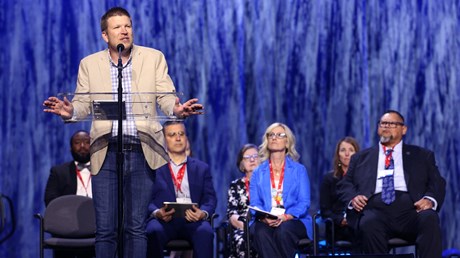
Jules Woodson remembers the spark of hope she felt when a sea of yellow ballots went up across the hall at the Southern Baptist Convention (SBC) annual meeting in 2022. The vote in favor of abuse reform following a watershed abuse investigation was her sign that the messengers cared about victims like her and were willing to listen and make changes.
At this year’s annual meeting in Indianapolis, the recommendations on abuse reform passed again, with another wave of thousands of ballots, but she teared up for a different reason: disappointment over how little had been done.
SBC entities have pledged millions to fund the cause. The convention has repeatedly voted in favor of abuse prevention and response efforts by overwhelming margins. Task forces appointed by the convention president have volunteered their time to develop training resources, a database of abusive pastors, and an office to oversee the ongoing work of abuse reform.
“For messengers for whom abuse isn’t on the forefront of their minds, they think, Oh, we’re doing good,” said Woodson, whose testimony of abuse by her Texas youth pastor launched the #ChurchToo and #SBCToo movements six years ago. “But there’s so much more to be done.”
The abuse victims and advocates calling for reform in the SBC are now watching Southern Baptist leaders within the convention try to navigate the kinds of denominational hurdles and roadblocks they faced for years from the outside.
“We’ve been told over and over again, You can’t do this, you can’t do that,” said Mike Keahbone, a candidate for SBC president who serves on the Abuse Reform Implementation Task Force (ARITF). “You have to ask yourself, Why in ...
Love in an Attention Crisis
Readers of the Latin Bible could see how close love and diligence are.

Anyone who has studied a foreign language knows the fun of stumbling across a word that looks familiar. It’s like a treasure hunt. In my first weeks of high school Latin, I found that my own surname, Vincent, was a Latin word for “conqueror,” which gave rise to the word vanquish. That’s a pretty cool find for a slightly bored 15-year-old!
It was my enthusiasm for surprising derivatives that inspired me to surf the pages of the Vulgate, which Jerome translated in the late fourth century. This Latin translation of the Hebrew and Greek Scriptures served as the standard translation of the Bible in churches throughout the Western world for centuries, and many of Jerome’s interpretive decisions provide a glimpse into the heart of the church’s historic understanding of Scripture. For me, it was a hotbed of etymological discoveries.
Several years ago, I stumbled across one such nugget of linguistic history hidden in the Vulgate. It started as I was reading the Great Commandment from Luke 10:27 (ESV throughout):
You shall love the Lord your God with all your heart and with all your soul and with all your strength and with all your mind, and your neighbor as yourself.
When Jesus told an inquisitive lawyer that all the Law and Prophets hung on these two commandments (Matt. 22:40), he knew that his audience would recognize them. Both were drawn directly from the Torah (Deut. 6:4–9; Lev. 19:18) and would have been intimately familiar. But Jesus imbued them with a new and shocking centrality, and he spoke them with an unprecedented authority (Matt. 7:29).
He also spoke them in a new language. Although Jesus himself spoke primarily Aramaic, the Gospels record his words in Greek, with “love” ...
Kids Aren’t Cheap. That Doesn’t Fully Explain Why We’re Ambivalent About Having Them.
A new book explores why what was once a default life stage now feels like an increasingly fraught choice.

In a recent Guardian article about “America’s premier pronatalists,” the journalist mentions her own assumption that “the main thing that [makes having kids] hard [is] that it’s now so incredibly expensive to raise children.”
“No,” the father of the profiled family replies. “Not at all”—and in a significant sense, I think he’s right. So do Anastasia Berg and Rachel Wiseman, authors of the newly released What Are Children For?: On Ambivalence and Choice.
That’s not to say Berg and Wiseman (or I) would ever be dismissive of the real financial hardships many would-be parents face. On the contrary, they devote the first of the book’s four long chapters to a sober examination of such “externals.”
But the delight of the book is that they do not stop there. Berg and Wiseman equally reject the assumption—seen in many lesser entries in the kids conversation—that the externals are the whole of the matter, that all this ambivalence would melt away with just the right package of policies to extend parental leave and make childcare affordable.
It wouldn’t, and What are Children For? is a welcome complication of that simplistic account. As the title signals, Berg and Wiseman aim to deliver a sharp cultural and philosophical analysis, giving rigorous but sympathetic examination to a “world that is both pro- and anti-natalist.” Though they embrace at the last moment a major claim they seem to resist throughout the text, their project succeeds.
A sea of options
Readers familiar with the Christian philosopher Charles Taylor’s idea of secularism in A Secular Age will be well-prepped to understand a core contention of ...
I’m an Evangelical Parent of Adult LGBTQ Children. Now What?
My theology is squarely orthodox. Now I need fellow Christians to help me work out a sustainable vision of day-to-day life with my children.

For evangelical parents who hold to the church’s long-standing doctrines on gender and sex, waking up to the reality of LGBTQ children in our homes frequently marks the beginning of a difficult journey.
Often blindsided by the development, many parents feel ill-prepared for the work of discernment required to move forward. They hunger for instruction and understanding. Above all, they yearn for relief from the burdensome fear of “getting it wrong” as they navigate uncharted waters requiring many choices, day after day, year after year.
This is the context that produces high turnout for events that try to help Christian parents find responses, beyond fight or flight, to their LGBTQ children—events like last year’s Unconditional Conference hosted by the church of influential pastor Andy Stanley.
The conference was controversial because it featured several speakers who don’t hold orthodox evangelical views on sex and gender. To prominent evangelical critics, the whole affair amounted to “a clear and tragic departure from Biblical Christianity” (Albert Mohler) and a “profound failure of pastoral responsibility” (Sam Allberry).
Similarly, in a more recent dustup, pastor and author Alistair Begg, who holds to the historical doctrine on marriage, saw his popular radio show dropped by a conservative Christian network. It came to light that he’d counseled a woman that she could attend her grandchild’s wedding to a transgender person, though she opposed the union on doctrinal grounds. Writing for First Things, theologian Carl Trueman argued that attending such a wedding is itself a doctrinal drift and “a very high price tag for avoiding ...
All Churches Should Require Background Checks
As a former police officer and PCA elder, I believe this basic step can protect congregations from predators.

For years, Jimmy G was seen as great guy and a leading member at his local community church—he was the go-to volunteer for all the ministries others avoided. On most Sunday mornings, you would see him serving alongside his wife in children’s ministry. But then something happened. Jimmy was suddenly arrested for multiple counts of aggravated sexual assault—some of them involving a minor. “Surely, Jimmy was framed,” thought everyone who knew him.
But then reports started showing up in local newspapers. This was not the first time Jimmy had been charged with such crimes. This had happened in another state years before, and his mode of operation was the same. It didn’t take long for new visitors to stop coming to this church—and as reports kept appearing on the front pages of local newspapers, even the faithful started peeling away from the congregation. The church’s reputation will take decades to recover in that close-knit small town.
I wish this account was fictional, but it isn’t. These events took place at a church in a neighboring community when I was a police officer. And although I’ve changed his name, the facts of his case, which I was privy to, are as stated. Sadly, this situation is repeated far too often in Christian churches today. During my time in law enforcement, I learned all too well how people with predatory proclivities can camouflage their activities behind church walls. And now, as the executive director of a large PCA church, I am personally aware of pastors’ immense responsibility to protect their flocks from harm.
Our churches are supposed to be sanctuaries of grace and peace, but the last few years have witnessed ...
The SBC’s Abuse Prevention Work Is Not Done
Five years ago, our messengers pledged to take substantive action to end sexual abuse in our churches. We cannot let another year pass with that promise unfulfilled.
Just over five years ago, a fire broke out in one of the world’s most famous houses of worship, the cathedral of Notre-Dame de Paris. In the days following, officials confirmed that one reason the fire grew out of control was that the security team, after hearing the alarm, miscommunicated and responded at the wrong location. The fire was in an attic, but the team went to the sacristy, located in an entirely different building. Portions of the cathedral soon burned to the ground.
It was also just over five years ago that alarms sounded in the Southern Baptist Convention (SBC) when reports emerged detailing hundreds of cases of sexual abuse in our churches and organizations over a span of decades. Since then, the eyes of the nation have been on America’s largest Protestant denomination as we’ve grappled with how to respond to these revelations and prevent future sexual abuse. This includes an ongoing investigation by the US Department of Justice, which recently filed its first indictment.
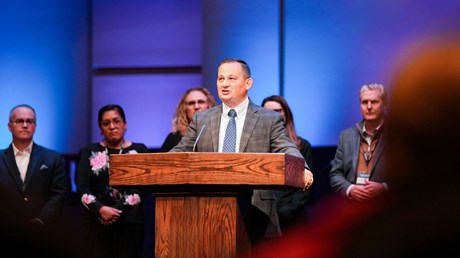
As an SBC pastor for more than 20 years, it saddens me to report that, rather than fighting our fire with every available resource, efforts to extinguish sexual abuse in the SBC have been hindered by distractions and delays. As messengers gather in Indianapolis for the SBC annual meeting this week, it remains unclear whether addressing our abuse crisis is still a priority for the SBC. This concern is magnified by the latest update from our abuse implementation task force: After two years of painstaking work by faithful volunteers, their tasks were not completed due to several “obstacles and challenges.”
Five years ago, recall, our initial reaction to the abuse revelations was a unified ...
The Generous Genius of Jürgen Moltmann
Memories and reflections of the famed theologian from his last overseas doctoral student and friend of 33 years.
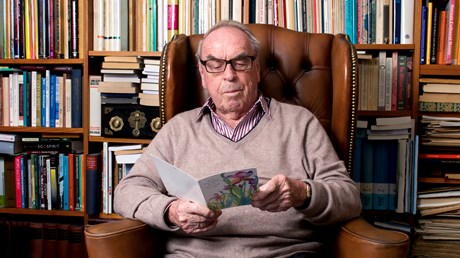
When he died at home in Tübingen, Germany, last Monday morning at age 98, the world could justly say that Jürgen Moltmann was the leading Christian theologian of the second half of the 20th century. He had championed liberation theology from South America, then imported it successfully to the West. He had inaugurated an eschatological “theology of hope” and freshly underlined the role of the Holy Spirit in mainstream Protestant and Catholic theology alike. His 1973 book, The Crucified God, had developed an almost instantaneous following among evangelical Christians on both sides of the Atlantic, and the full list of Moltmann’s literary output is dazzling.
I was Moltmann’s last overseas doctoral student, and we were close friends for 33 years. On Wednesday, I will fly to Germany to attend his funeral and interment at Tübingen. But today, I want to share with you a glimpse of his remarkable and faithful life.
Moltmann’s theological thinking emerged initially as the result of his captivity, from 1945 to 1948, as a German prisoner of war in Britain, as well as his searing experience as a teenage anti-aircraft gunner during the 1943 British air raid on Hamburg, his native city. After the war ended, he returned to Germany and studied theology at Göttingen under the Reformed theologian Otto Weber, and was much influenced by Karl Barth.
Moltmann then spent five years as a local pastor outside Bremen, during which time his wife Elisabeth gave birth to a stillborn child. It seemed an absurd and despairing event at the time, before the couple would go on to have four healthy daughters—how much more loss could God impose?
After that early pastorate, Moltmann ...
Some Churches Call Clergy Sexual Misconduct an ‘Affair.’ Survivors Are Fighting to Make It Against the Law.
Advocates push for legislation criminalizing sex between ministers and those they spiritually guide.

Krystal Woolston struggled with her mental health as a teenager, but she headed to college hoping for a brighter future. Then, a married pastor who seemed to care about her gave her a different path forward. He told her God wanted her to have sex with him to help her heal.
Looking back 12 years later, Woolston realizes how vulnerable she was to his spiritual manipulation.
“I was just falling, freefalling in so many ways,” Woolston said. “Everyone deserves to be able to go to church and be safe.”
It took her six years to understand this pastor’s pattern of “special treatment” was really manipulation and that the sex was, in fact, abuse. It took four more years to get her denomination to stop him from leading church youth trips.
Woolston doesn’t want anyone else to go through the same thing.
She and a small group of abuse survivors and advocates have been working to make sure it doesn’t. They want sex between clergy members and adults they are spiritually guiding to be illegal in all 50 states. It is currently only against the law in 13, including Connecticut, Tennessee, and Wisconsin, plus the District of Columbia. But advocates are working behind the scenes to introduce state legislation saying that these kinds of relationships, often characterized as “affairs,” are not consensual but criminal.
“Criminalizing abuse is another way of saying, Here, see, it’s abuse,” said Kate Roberts, an adult clergy-abuse survivor and cofounder of Restored Voices Collective. “The more it is legitimized as abuse in various ways, the better that is for prevention and for survivors getting the help that they need.”
Many states have laws that say people in ...
Most Pastors Still Oppose Same-Sex Marriage
Levels of support for LGBTQ relationships have plateaued among Protestant clergy.
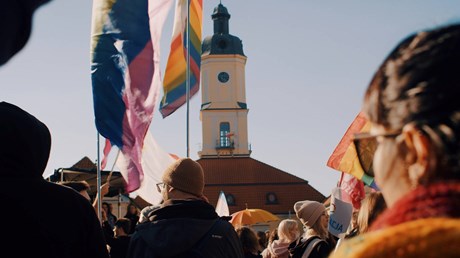
Almost a decade after the Supreme Court legalized same-sex marriage across the country, most pastors remain opposed, and the supporting percentage isn’t growing any larger.
One in 5 US Protestant pastors (21%) say they see nothing wrong with two people of the same gender getting married, according to a Lifeway Research study.
Three in 4 (75%) are opposed, including 69 percent who strongly disagree with same-sex marriage. Another 4 percent say they aren’t sure.
Previous Lifeway Research studies found growing support among pastors. In 2010, 15 percent of US Protestant pastors had no moral issues with the practice. The percentage in favor grew to 24 percent in 2019. Today, support is statistically unchanged at 21 percent.
“Debates continue within denominations at national and judicatory levels on the morality of same-sex marriage, yet the overall number of Protestant pastors who support same-sex marriage is not growing,” said Scott McConnell, executive director of Lifeway Research. “The previous growth was seen most clearly among mainline pastors, and that level did not rise in our latest survey.”
Pastors are slightly more supportive of legal civil unions between two people of the same gender, but most still disagree. Currently, 28 percent back such arrangements, statistically unchanged from the 32 percent in 2019 and 28 percent in 2018.
The previous growth in clergy support of same-sex marriages was driven by US mainline Protestant pastors. In 2010, a third (32%) were in favor. By 2019, almost half (47%) saw nothing wrong. Current support among self-identified mainline pastors remains at similar levels (46%).
Evangelical pastors have been consistently opposed to same-sex marriage. Fewer than 1 ...
I’ve Preached the Gospel Countless Times. The Love of the Amish Preached it to Me.
An excerpt on grief, forgiveness, and the gospel from Beechdale Road: Where Mercy Is More Powerful Than Murder.

On Sunday, June 21, 2020, 18-year-old Linda Stoltzfoos of Bird-in-Hand, Pennsylvania, was kidnapped and later murdered by Justo Smoker—my brother-in-law.
As you might expect, my family journeyed through tremendous grief, anger, and pain. But as you might not expect, we also journeyed through the challenge of receiving unexplainable grace, kindness, and mercy at the hands of the Amish community, of which Linda Stoltzfoos was a part.
The story to be told is not just another story of grief and healing but a story about the gospel. It’s a gospel story embedded in the very tangible way the Amish community poured out grace and mercy on my family—and our struggle to receive it. As a pastor for over 20 years, I have preached the gospel countless times, but through my encounters with the Amish community, it was preached to me in a way that was deeper and more personal than anything I’ve ever encountered before.
Many years ago, I memorized Paul’s words in Ephesians 2:8–9: “For it is by grace you have been saved, through faith—and this is not from yourselves, it is the gift of God—not by works, so that no one can boast.” But in the last four years, for the first time in my life, I’ve had to wrestle with what it really means to receive unmerited grace when there is absolutely nothing you can do to make things better on your own. My family experienced what it’s like when undeserved mercy confronts undeniable evil, when kindness upends condemnation, when heaven engages hell.
This experience began with a knock on the door that I had no interest in answering. I was in no mood to talk to anyone just a few hours after it became public that Justo ...
Guilty Verdict Shakes Trump Supporters’ Faith—in the Justice System
Many white evangelicals don’t trust the felony conviction and still back the former president.

Donald Trump’s historic felony conviction in New York on Thursday hasn’t deterred his evangelical supporters. Instead, along with fellow Trump loyalists, they have directed their ire at the justice system that issued a guilty verdict against him.
“People think this is kind of the end of America,” Chad Connelly, CEO of Faith Wins, a conservative Christian organization, told CT. “I don’t talk to anybody that thinks this is anything other than a sham case.”
A jury of 12 New Yorkers found Trump guilty on all 34 counts brought by Manhattan district attorney Alvin Bragg, concluding that Trump falsified business records as part of an effort to keep a sex scandal from influencing the 2016 US presidential election.
“This was a rigged trial by a conflicted judge who was corrupt,” Trump told reporters in a brief statement after leaving the courtroom.
“The real verdict is going to be November 5 by the people,” Trump added. “We didn’t do a thing wrong. I’m a very innocent man. … Our whole country is being rigged right now.”
Connelly, who previously served as the Republican National Committee’s national director of faith engagement, said that he believes the verdict will only “strengthen people’s resolve” to vote for Trump come November.
More than 9 in 10 white evangelical voters said a guilty verdict in the hush money trial would make no difference in their vote or would make them more likely to back Trump, according to an NPR/PBS NewsHour/Marist poll conducted last week. Only 7 percent of white evangelicals said a conviction would make them less likely to vote for him for president.
Overall, two-thirds ...
India’s Christians Brace for 2024 Election Results
Church leaders mobilized prayer for parliament and state elections, knowing the question wasn’t whether Hindu nationalists would win but the size of their mandate.
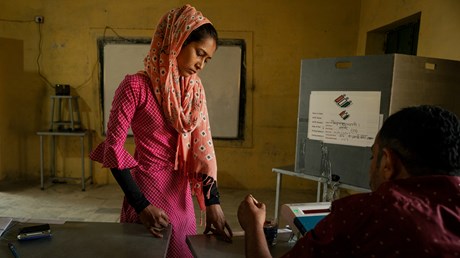
As India’s monumental elections finally come to an end this week, all eyes are on the extent of the mandate that will be handed to Prime Minister Narendra Modi and his Hindu nationalist party. Especially among the subcontinent’s estimated 28 million Christians, for whom the result will test whether religious freedom and secularism will be preserved in the world’s largest democracy.
Modi’s Bharatiya Janata Party (BJP) has been in power since 2014. During this time, monitoring groups have documented an alarming increase in incidents of violence, discrimination, and harassment targeting religious minorities–especially Christians and Muslims. Hindu extremist groups, emboldened by the BJP’s ideology of Hindu supremacy or “Hindutva,” have systematically perpetrated abuses ranging from physical assaults to false accusations of forced religious conversions, used as a pretext for persecution.
A massive survey by the Pew Research Center reported that in 2019, about 49 percent of Hindu voters in India backed the BJP, which secured the party a majority in the Lok Sabha, the lower house of India’s parliament, and granted Modi a second term as head of state.
Not who wins, but by how much
The 2024 Indian general election, which started polling votes on April 19, will conclude on June 1 after being conducted in seven staggered phases. The prolonged election process has drawn criticism from opposition parties alleging it favored the BJP’s “money power.” Meanwhile the Election Commission of India has come under criticism for “failing” its constitutional duty and is seen by observers as compromised.
At stake is the composition of the 543-seat Lok Sabha, which will ...
The Moral Confusion Around Trump’s Felony Conviction
Among the former president’s antagonists and admirers alike, there is a great deal of calling evil good and good evil.
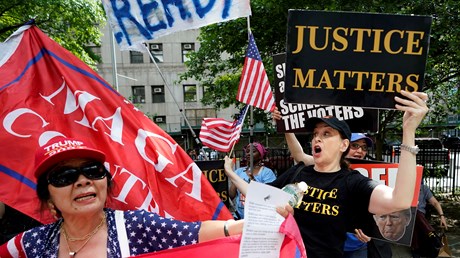
The homepage of The New York Times announced the conviction of Donald Trump on 34 felony charges Thursday afternoon in the kind of large-scale, black letter headline we typically associate with yellowed century-old newspapers declaring war has come. “TRUMP GUILTY ON ALL COUNTS,” it blared above a photo of the former president looking weary in some crowded public space.
Scrolling down the page a little, you’d have found a link to one story noting the historicity of this moment and a link to another story detailing each of the 34 charges. Together on the homepage, the headline of the first paired with a bulleted summary of the second made for a strange juxtaposition: “Donald Trump has become America’s first felon president,” it said, and below that, a bulleted list: “11 counts related to invoices, 12 counts related to ledger entries, 11 counts related to checks.” Wait, invoices? This isn’t exactly the crime of the century.
And that highlights the core problem with the most common responses to this verdict in our political discourse: Among Trump’s antagonists and admirers alike, there is a great deal of calling evil good and good evil (Isa. 5:20).
I doubt this is deliberate dissembling. The most animated reactions I’ve observed have not been calculated—quite the opposite, in fact. Outside the chattering class especially, those responses have looked like organic outbursts of elation and schadenfreude, or else indignation and resentment. On both sides, I believe that most people sincerely see their reactions as stands for justice. But even with innocent motivation, this is a kind of moral confusion.
Let’s start with Trump’s opponents, among whom there ...
Pakistan’s Christians Fear Forced Marriages. Punjab Court Ruling Brings New Hope
Church leaders and human rights experts weigh in on whether raising the legal age is sufficient in shielding minors.

Nearly one in five (18.3%) Pakistani girls are married before age 18, according to data from 2017 to 2018, with over half becoming pregnant as children. Many of these girls are of Christian or Hindu faiths that collectively make up 3.5 percent of the population, which is majority Muslim.
While the government has officially banned child marriage, discriminatory laws and lack of enforcement have allowed the practice to persist. Most child marriages are arranged by families, but an estimated 1,000 girls are abducted, converted to Islam, and then forcibly married to their abductors each year. These child brides face heightened risks of pregnancy-related health complications and maternal mortality.
A recent ruling by the Lahore High Court could provide another tool for advocates and church leaders trying to protect Pakistani girls. In April, it struck down a provision of the 1929 Child Marriage Restraint Act that set the minimum marriage age at 16 for girls but 18 for boys. Deeming this definition of a child as “discriminatory and unconstitutional,” the court directed the province of Punjab to revise the law with a uniform minimum age of 18 for both genders.
The judgment cited Pakistan’s constitutional guarantees of gender equality and protection of women and children’s rights and presented data showing how adolescent pregnancy is one of the leading causes of death for 15- to 19-year-old girls.
“We, as a nation, woefully lag behind in all major indicators, and half of our population cannot be lost to childbearing at an early age while its potential remains untapped,” wrote Justice Shahid Karim. “Equal opportunities for females mean equal restraint on marriage as the males.”
As Punjab ...
Died: Lin Chih-Ping, Taiwan’s ‘Fool for Life’ Who Shared ‘Cosmic Light’ Through Eclectic Ministry
The entrepreneur and social services leader had a unique vision for sharing the gospel and reaching people holistically.

Peter Chih-Ping Lin (林治平), who launched a Christian magazine for those outside the church that grew into a sprawling, eclectic ministry, died of pancreatic cancer on April 27 at the age of 86 in Taipei. With little financial support, in 1973, Lin founded what became Christian Cosmic Light Holistic Care Organization, which sought to reach non-Christians through art, academic research, and social work. As a leader in Christian social services, Lin’s concern for the marginalized led him to lead the Christian drug rehab organization Operation Dawn in Taiwan and to reset the vision of Bethany Children’s Home.
Lin’s work often operated on a shoestring budget, forcing him to be entrepreneurial and to rely on his faith.
“When we walk in God’s calling and what he has entrusted us with faith, God will certainly lead us through all the hardships and trials for us to finish the missions we carry,” Lin wrote in 2023, in an issue commemorating Cosmic Light’s 50th anniversary.
Lin was born in Changsha, a city in Hunan Province in central China, on May 22, 1938, not long after the Second Sino-Japanese War broke out. Because his father served in the Chinese air force, regularly facing Japanese airstrikes and heavy artillery, Lin’s childhood was constantly disrupted. For the first ten years of his life, his family lived in nearly half of China’s 23 provinces, and his parents named their son Chih-Ping (Chih means “to rule,” Ping means “peace”), expressing their desire that, one day, he would know stability.
This dream was only realized after Lin lost his sister, and his mother and the remaining children fled to Taiwan in 1948. At age 10, Lin was now living in a farming ...
Kwame Bediako Still Defines the Debate on African Culture and Christianity
Seven leaders weigh in on the late Ghanaian scholar’s provocative legacy 20 years after his best-known book.
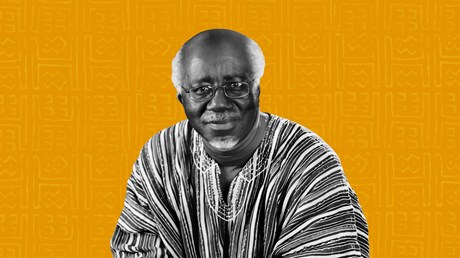
What Luther and Calvin are for evangelical Christians globally, Kwame Bediako is for many African evangelicals. From his dramatic conversion in 1970 to his death in 2008, Bediako was the primary architect of and inspiration for theological work that grappled with the realities of African culture.
On this 20th anniversary of the publication (by Orbis Books) of some of Bediako’s most influential essays in Jesus and the Gospel in Africa: History and Experience, his memory still reverberates across the continent, as indicated by the seven reflections collected below on his ongoing influence.
Born and raised in Ghana, Bediako was a professing atheist studying existentialist literature as a doctoral student in Bordeaux, France, when an awareness of Christ as the truth powerfully overwhelmed him while he was showering. He finished his degree in French literature but turned his powerful mind to the Bible and theology, later completing a second doctorate in Aberdeen, Scotland, under missiologist Andrew Walls, who called Bediako “the outstanding African theologian of his generation.”
Bediako attended the First International Congress on World Evangelization in Lausanne, Switzerland, in 1974, meeting other prominent Majority World evangelicals including René Padilla, Samuel Escobar, and Vinay Samuel. At that time, he conceived the idea of a research center on the relation between the gospel and African culture. With support from his denomination, the Presbyterian Church of Ghana, that vision was realized as the Akrofi-Christaller Institute of Theology, Mission and Culture (ACI) in 1987.
While self-consciously evangelical, Bediako sought connections between the gospel and African traditional ...


